Showing posts with label living on the Interwebz. Show all posts

2 Jul 2013

The Great Drumming Circle of Life - a love letter to technology

Let me tell you a story.

When he was very little, about eight I think, my brother was given a drums kit as a present. My mum wasn't entirely thrilled, but he was ecstatic. We still have pictures of 3 years old him playing with his toddler plastic kit; I guess my parents should've seen it coming. So my mum thanked the present giver for his generous, if not excessively loud gift, and scoured the Internet for someone to teach little Alex. She found a nice guy in his late teens who'd come to the house on his skateboard and show my bro how to bang his toms, and he got better, and everyone got happier.

The bro back in the day, when his kit was so new it hasn't made it to his room yet

Fast forward almost ten years. My brother still plays drums, and at the end of every year, his music school puts on several gigs for all kids to perform songs they rehearse during the year. Kids pick the songs at the beginning of the year, a way to get them more involved and motivated. My little brother, now 17, picked a song by the French band Shaka Ponk, one of his favourite bands — they're so cool he actually got the whole family hooked!

And man, the world must be a really tiny thing, because Shaka Ponk's current drummer is none else than that teenager on his skateboard.

But the best part is, I got to watch him play it live.

I got to see him play a gig live in a small town in Western France while sitting in my living-room in London, England; thanks to my dad deciding to Skype in from the audience; thanks to his phone network being strong enough to handle it; and thanks to my Internet connection staying live for ten minutes straight for once.

The Internet and all these brilliant little pieces of technology allowed me to be part of an event that my family and I have been attending for years, and watch my brother complete what I shall from now on refer to as the Great Drumming Circle of Life. So yes, you guessed it, I teared up a little bit. I suddenly had a lot of these things called feelings and got stuck in a warm bubble of gratefulness for a few days.

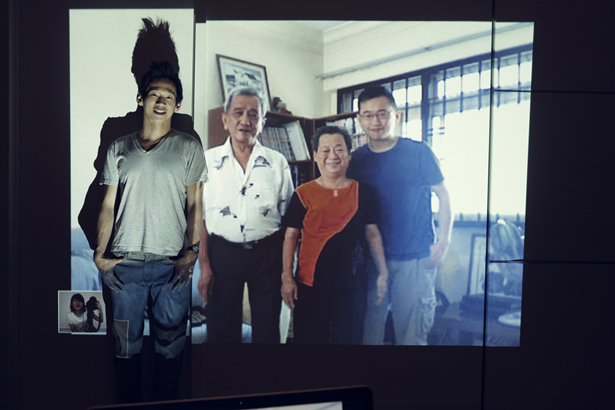
So many things are blamed every day on the Internet and technology. From children violence, procrastination and broken marriages to back aches, conspiracies and poor work performances, it always has a role to play in them. What people seem to often forget or at least downplay, in my opinion, is the other side of the coin. Internet connects people. I really like John Clang's Being Together series of Skype family portraits.

Being Together - John Clang
Clang told The Atlantic: "I am marking the time for these families, enabling them to remember these strange moments of togetherness with the technology presently available. The picture (...) embraces the intimacy and closeness of a family, no matter how far apart they are."

In a strange manner, but a way that I think many expats have experienced, distance has brought me closer to my family. When I get to see them, I enjoy the moments as much as I can because I rarely know when I'll be home next. And when I get to skype them, or receive an email from my mum showing off her new shoes, or wake up to a video message on Whatsapp to wish me happy birthday, I feel a little tingle of sadness that we're apart.

But first and foremost, I'm grateful that technology makes it possible for us to be together for big things and small things and everyday things.

18 Apr 2013

Taking a break from essay writing to write about essays

I came back to London ten days ago after two weeks in France, and since then, all I've seen of London is my house/the library/my work place.

Mostly the library.

As I sat at a desk in front of my open computer for what feels (and probably is) the thirtieth hour this week, I got a blog post idea. This never happens; as you can imagine from the lack of posts lately, I don't get blog post ideas. But as always, it happened when I should have been doing something else.

I'm currently writing a portfolio of essays for one of my courses. Once again, I chose YouTube as my leading example. This is the great thing about my course and the reason why despite everything, despite the occasional terrible modules and the overall feeling of 'is this really worth it?', I'm 100% I chose the best and rightest course for me: I study what I do.

I study the media, and the media are what I do. I write a blog, I tweet, I make videos online, I spend countless hours on Facebook; all these things are part of my life, and I'm lucky enough that I'm learning why and how they're this important to me and most of our society. A lot of people say media students don't do eff all; allow me to disagree.

YouTube and Facebook have more than one billion active users a month. That's just under 10% of the world population. We are all always connected to something, almost all of us have phones (often smartphones), we watch TV, we listen to the radio; all of this is everywhere. It's not insignificant. And studying the media is as significant as studying geography. I believe the media shape the society we live in today: if it wasn't for a website such as Mediapart, French politicians wouldn't be double checking all of their secret Swiss accounts right now. If it wasn't for Twitter, some say the Arab Spring wouldn't have happened (others disagree, but my opinion is that social media strongly helped.)

And if it wasn't for the media, at least 50% of my life would be different. For a start, I wouldn't be doing all the things I mentioned before. And you wouldn't be here. I'd say at least a quarter of the readers of this blog wouldn't know I exist.

This is what's great about the media: we make it. The portfolio of essays I'm writing is all about this: who produces the media and culture, what's the role of audiences, where to draw the line between production and consumption. My view is that there isn't a line.

In my essay, I mentioned Rosianna Halse Rojas, a blogger and vlogger and Internet person who makes videos at missxrojas. I had a question for her, I tweeted at her, she replied in less than five minutes. She serves as a valid, relevant academic media example for an essay that is very much important to my degree. And she is also the housemate of a mate, and reads and replies my tweets. This is not name dropping, but a real observation; one that might seem obvious but which in my opinion means a lot to our society.

It's normal people, like you and me, who make the media. We make the culture. We make the Internet.

True, we don't make all of it. When we post videos online, we use video hosting websites. Money and mainstream ideologies and the political agenda and many other factors have a strong influence on everyone's work and ideas. And true, the "we" I'm talking about is restricted to those of us who actually have access to a computer.

Still, I don't think this is a fact to be overlooked. It's not just companies. It's not just VEVO and ITV and Hollywood, it's also us, and Alex "the future of music" Day, and the backers of the Veronica Mars movie Kickstarter, and missxrojas. And it can be you too.

Now back to my essay, because this 2:1 is not going to write itself.

13 Jan 2013

Expats and relationships: the curse of long distance

I have a complicated relationship with my front door.

On the one hand, the very fact I have a front door means I have a house, which is always appreciated for things like sleeping, making food, or just dancing in my pyjamas to the songs of Ed Sheeran. The people who open my front door are often my housemates coming home, or friends coming to visit, or the delivery guy with shoes/cookbooks/mystery parcels and I like all those things.

It's true that my front door is an absolute pain to open, but at least I'm assuming it'll discourage burglars from popping in to steal our stuff. Which is also good, because I like our stuff.

The problem I have with my front door is that I keep having to stand in its frame saying goodbye to people I love without knowing when I'll see them next.

Being an expat sucks.

I can already hear the 'Oi, you suck, you dirty ungrateful froggie,' so please bear with me. Yes, being an expat is all kinds of marvellous. Great experience, great fun, new things all the time—woohoo! Yes, being away from people is an almost compulsory aspect of my generation's lives. We are lucky enough to live in a globalised world, a world of networks, of high speed trains and cheap charter planes, an online world where relationships happen as much on screen as they do in the physical world.

Except sometimes it's just not the same.

I've argued before that friendship on the Internet is a real, true thing and that I believe most people who position themselves against it are people who have not experienced it. I stand by this idea, but I want to add something: although friendship on the Internet is a thing, a) it is made stronger by meeting up face-to-face and b) chatting to someone on Skype is but a sad consolation when you're used to seeing someone every day and hugging them whenever you feel like it.

My mum came to visit in December and I had to close the door on her leaving. Wasn't fun (especially since it was 6am.) But at least, in this instance, I knew I was going to see her again a couple weeks later. Except when I got on the train back to the UK after Christmas, I didn't know when I was going to see her or my family next (and I still don't.)

Front doors, trains—everything I used to love has been expat-cursed into evil.

This week, one of my best friends came to visit, and I had to watch her go having no idea when I'd see her next. She doesn't live in my hometown, and studies on the other side of France from where we went to high school. Meeting up is such a challenge we probably deserve gold stars for managing it every so often. When you live abroad, planning anything with people-from-back-home becomes an absolute nightmare (and more so when people-from-back-home are expats as well. Fun timez.)

Friendship takes on a new meaning and has to be adapted to everyone's new life. Once again, I guess this is an issue of our time. Relationships are evolving. It's good, it challenges you in a good way, it asks for effort. But relationships should be able to exist without being at risk of becoming chores. Distance turns some relationships in nothing more than the nostalgia of what it used to be. And it sucks.

This being said, those who know me know that I could be saying the opposite of this tomorrow. I love being an expat, but sometimes I really, really wish teleportation would finally be invented so that I could at last stop tearing up on my doorstep.

#rantover

23 Jul 2012

The Internet is real

People usually make a difference between what happens on the Internet and IRL.

In Real Life. So the internet isn't real, then?

I assume what causes people to think the Internet is but a virtual place is its infinity. Everything is on the Internet. Everyone can be anyone. Anyone can do anything. And yes, people can use masks and pretend to be persons they are not. The Internet makes it easy to forget one's responsibilities and only follow one's instincts.

And yes, it lacks the physical aspect.

That doesn't mean it's not real.

People regard the web as a consequence-free place. I disagree. There is a person behind every Internet profile, website, picture or video. These persons think and feel. Whether they choose to remain anonymous or not, whatever they say or do online still has consequences on their mental beings. If it doesn't, I believe the Internet isn't the reason; rather, it is because they are oblivious of their actions in general.

And who is to say exchanges and relations on the Internet aren't real because one can't touch? Breaking news: this is the 21st century. We go online to do quite everything. Shop, call our families, book concert tickets, look for recipes, contact our bank, listen to music, and what not. And, yes, make friends too. Find love, too.

I'm going to use my own example to illustrate this point since it's the one I know best. I think most readers of this blog know me personally, and thus are aware that some of my friends I met online. But some of you might not realise how many, and how close we can be. I met Laure, one of my closest friends, through an online forum. We've known each other five years and went on holidays abroad together two years ago. Sothea, the one friend who sends me the cutest and greatest birthday card every year I met online. I just had Nicole spend the week-end at my place. We met through Youtube a few months back. And yesterday, we were together on a beach, in bikinis—it doesn't get any closer, really.

Believe me, these relationships are all very real. And they were just as much real when they started online.

Maybe the key of this debate is what definition of realness one has. According to the online Oxford Dictionaries, real is
"actually existing as a thing or occurring in fact; not imagined or supposed"
Well, then. No motion about physical contact. If it's happening to you, it's real. And if the other person was pretending to be someone they're not, it will hurt. And that's real.

Besides, in the globalised world we live in, it's most likely safe to assume everyone is in at least one long-distance relationship. Children leave. Friends move. Cousins live across the country. Colleagues are transferred abroad. But everyone agrees that these relationships are real. And yet, they rely as much on phone, emails and Skype as the ones that started online.

Double standard much?

Trust me. I live on the Internet. As I live on Earth. The Internet is everywhere. There's no escaping. We need it to make the world go round, today.

So, real or not real? I tell you, real.

***

Les gens font souvent la différence entre ce qui se passe sur Internet et IRL.

In Real Life. Dans la vraie vie. Bien réel. Donc Internet n'est pas réel ? 

Je suppose que c'est son infinité qui pousse les gens à croire qu'Internet n'est qu'un endroit virtuel. On trouve tout sur Internet. N'importe qui peut être n'importe qui. Et faire n'importe quoi. Et effectivement, certaines personnes peuvent se cacher derrière des masques et prétendre qu'elles sont quelqu'un d'autre. Il est facile d'oublier ses responsabilités sur Internet, et de seulement suivre ses instincts.

Et effectivement, il y manque l'aspect physique.

Mais ça ne veut pas dire que ce n'est pas réel.

Les gens considèrent qu'Internet est un endroit où on peut faire n'importe quoi sans conséquences. Je ne suis pas d'accord. Derrière chaque profil, site, photo ou vidéo sur Internet, il y a une personne. Ces personnes pensent et ont des sentiments. Qu'elles choisissent de rester anonymes ou non, ce qu'elles font et disent en ligne auront des conséquences, ne seraient-ce que mentales. Et si ce n'est pas le cas, je ne pense pas qu'Internet en soit la raison ; je pense plutôt que ces gens n'ont pas conscience de ce qu'ils font en général.

Et qui peut dire que les échanges et relations qui se passent sur Internet ne sont pas réelles parce qu'on ne peut pas se toucher ? Scoop : nous sommes au 21ème siècle. Internet est utilisé pour tout et n'importe quoi. Faire les courses, appeler nos familles, acheter une place de concert, trouver une recette, contacter la banque, écouter de la musique et que sais-je d'autre. Et oui, se faire des amis fait partie de la liste. Et trouver l'amour aussi.

Je vais me servir de moi-même en guise d'exemple, vu je me maîtrise pas mal. Il me semble que la plupart des lecteurs de ce blog me connaissent personnellement, et sont donc au courant que j'ai rencontré certains de mes amis via internet. Mais certains d'entre vous ne réalisent peut-être pas combien et à quel point je suis proche d'eux. J'ai connu Laure, l'une de mes plus proches amies, sur un forum. Ca fait cinq ans qu'on se connait et il y a deux ans, on est parties en vacances à l'étranger ensemble. J'ai connu Sothea sur Internet, et chaque année, elle m'envoie une carte d'anniversaire—toujours la plus jolie de celles que je reçois. Je viens d'avoir Nicole à la maison pour le week-end. On s'est rencontrées via Youtube il y a quelques mois. Et hier, on était ensemble à la plage, en bikini—on ne peut pas faire plus proches.

Croyez-moi, ces relations sont toutes bien réelles. Et elles l'étaient tout autant quand elles se sont crées en ligne.

Peut-être que la clé du débat, c'est notre définition de réel. D'après le Larousse, est réel ce
"Qui existe ou a existé effectivement"
Donc, voilà. Pas de mention de contact physique. Si ça vous arrive, c'est réel. Et si la personne en face prétendait être quelqu'un d'autre, vous en souffrirez. Et ça, c'est bien réel.

De toutes façons, dans le monde globalisé dans lequel on vit, je pense qu'on peut sans crainte avancer que chacun d'entre nous est impliqué dans au moins une relation longue-distance. Les enfants quittent la maison. Les amis déménagent. Les cousins vivent de l'autre côté du pays. Les collègues sont mutés à l'étranger. Tout le monde est d'accord pour dire que ces relations sont réelles. Et pourtant, elles reposent autant sur le téléphone, les emails et Skype que les "relations Internet."

Deux poids deux mesures, non ?

Faites-moi confiance. Je vis sur Internet. Tout comme je vis sur Terre. Internet est partout. On ne peut pas y échapper. On en a besoin pour que le monde tourne rond.

Alors, réel ou non ? Pour moi, c'est réel.